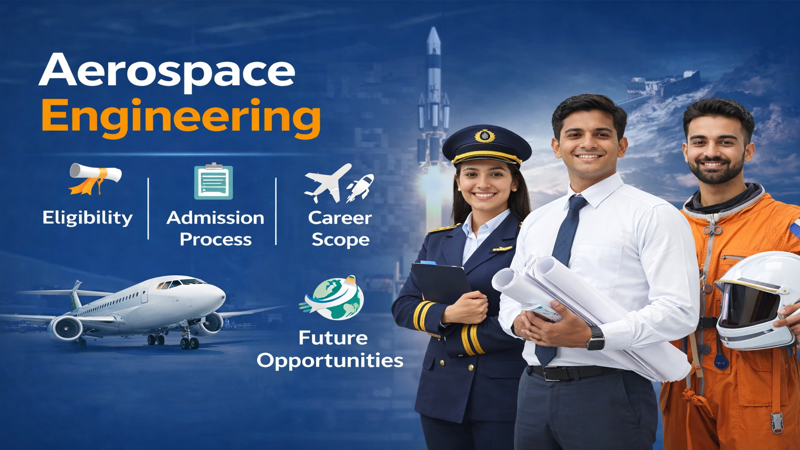
Aerospace Engineering: Career Scope, Eligibility, Courses & Future Opportunities
Aerospace Engineering focuses on the design, development, and maintenance of aircraft, spacecraft, satellites, and defense systems. This field combines advanced engineering principles with cutting-edge technology to support aviation and space exploration. Students gain expertise in aerodynamics, propulsion systems, avionics, and structural design. Aerospace Engineering offers excellent career opportunities in aviation, defense, research organizations, and space agencies worldwide. With growing innovation in aerospace technology, this course provides a future-ready and globally respected career path.
Aerospace Engineering is a highly specialized and innovative field that focuses on the design, development, testing, and maintenance of aircraft, spacecraft, satellites, and defense systems. It is one of the most prestigious engineering disciplines, combining advanced technology, physics, and mathematics to create solutions for air and space travel. With rapid advancements in aviation and space exploration, aerospace engineering offers exciting global career opportunities.
What is Aerospace Engineering?
Aerospace Engineering is the branch of engineering concerned with the science and technology of flight. It is broadly divided into two major fields:
Aeronautical Engineering – deals with aircraft that operate within Earth’s atmosphere.
Astronautical Engineering – focuses on spacecraft, satellites, and space exploration systems.
Aerospace engineers work on aircraft design, propulsion systems, avionics, aerodynamics, structural analysis, and space technologies.
Aerospace Engineering Course Overview
Aerospace Engineering is offered as a Bachelor of Technology (B.Tech/B.E.) degree, typically lasting 4 years. Some institutions also offer diploma and postgraduate programs (M.Tech/MS) in aerospace and allied fields.
Key subjects covered include:
Engineering Mathematics
Aerodynamics
Aircraft Structures
Propulsion Systems
Flight Mechanics
Avionics
Spacecraft Technology
The course combines theoretical learning with laboratory work, simulations, and real-world projects.
Eligibility Criteria
To pursue Aerospace Engineering, students must meet the following eligibility requirements:
Completion of 10+2 with Physics, Chemistry, and Mathematics (PCM)
Minimum 50–60% aggregate marks (varies by institution)
Qualification in entrance exams such as JEE Main, JEE Advanced, or other state-level engineering exams
Admission Process
Admission to aerospace engineering programs is primarily based on:
National-level entrance exams (JEE Main/Advanced)
State-level engineering entrance exams
Merit-based admission in private institutions
Top institutes in India include IITs, IIST, IISc, and other reputed engineering colleges.
Career Scope in Aerospace Engineering
Aerospace engineers are in high demand across various sectors, including aviation, defense, space research, and manufacturing. Popular job roles include:
Aerospace Engineer
Aircraft Design Engineer
Avionics Engineer
Flight Test Engineer
Aerospace Research Scientist
Maintenance and Safety Engineer
Graduates can work with organizations such as ISRO, DRDO, HAL, NASA (internationally), private aviation companies, and defense agencies.
Salary and Job Opportunities
The average starting salary for aerospace engineers in India ranges from ₹4 to ₹8 LPA, depending on skills and employer. With experience and specialization, professionals can earn significantly higher salaries, especially in international aerospace organizations and research centers.
Higher Studies and Global Opportunities
Students can pursue M.Tech, MS, or PhD in Aerospace Engineering or related fields. Countries like the USA, Germany, Canada, France, and the UK offer excellent opportunities in aerospace research and advanced manufacturing.
Why Choose Aerospace Engineering?
High-demand and future oriented field
Opportunities in space exploration and aviation
Prestigious and well paying career
Global employment opportunities
Innovation driven and technology focused profession
Aerospace Engineering is an ideal career for students passionate about aviation, space technology, and innovation. With rapid advancements in space missions, defense systems, and commercial aviation, the demand for skilled aerospace engineers continues to grow. Choosing aerospace engineering opens doors to an exciting, challenging, and globally respected profession.