Communication Studies and the Humanities & Social Sciences: Why They Matter in a Changing World
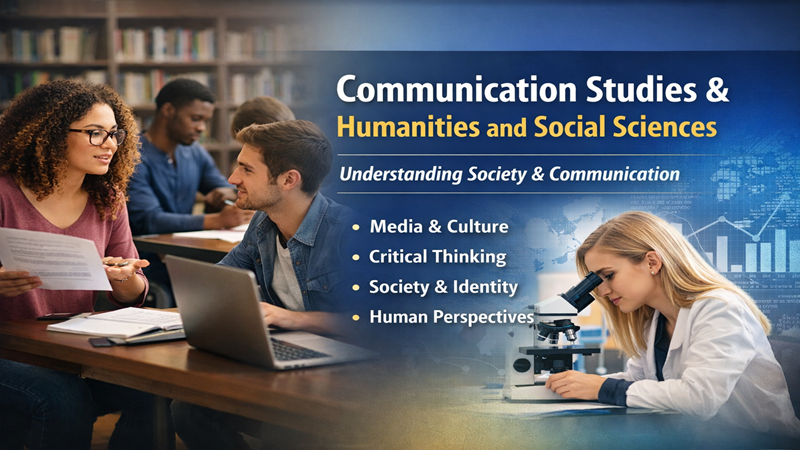
Academic content highlighting Communication Studies and Humanities & Social Sciences, emphasizing critical thinking, culture, media, and societal impact.
In an era defined by rapid technological advancement, global connectivity, and complex social challenges, Communication Studies and the Humanities & Social Sciences (HSS) play a vital role in shaping informed, ethical, and engaged societies. Far from being abstract or purely academic fields, these disciplines equip individuals with the critical thinking, cultural awareness, and communication skills needed to navigate and influence the modern world.
Understanding Communication Studies
Communication Studies explores how people create, share, interpret, and negotiate meaning. It examines communication across interpersonal, organizational, media, political, and digital contexts. From public speaking and media analysis to intercultural communication and strategic messaging, the field helps us understand how ideas influence attitudes, behaviors, and social change.
In professional settings, strong communication is no longer optional it is essential. Employers increasingly value graduates who can articulate ideas clearly, collaborate across cultures, and adapt messages for diverse audiences. Communication Studies provides these practical competencies while grounding them in theory and research.
The Broader Role of the Humanities & Social Sciences
The Humanities & Social Sciences encompass disciplines such as sociology, psychology, political science, history, philosophy, and cultural studies. Together, they seek to understand human behavior, social structures, values, and power relations. These fields encourage us to ask critical questions: How do societies function? What shapes identity and culture? How should we respond to inequality, conflict, and ethical dilemmas?
By studying HSS, students develop analytical reasoning, ethical judgment, and a nuanced understanding of social dynamics. These skills are crucial not only for academic inquiry, but also for leadership, policymaking, education, research, and community development.
Why These Fields Are More Relevant Than Ever
Today’s global challenges misinformation, polarization, social injustice, climate communication, and digital ethics cannot be solved by technology alone. They require human-centered perspectives. Communication Studies helps us understand how narratives spread and how dialogue can be fostered, while the Humanities & Social Sciences provide the frameworks to analyze social impact and guide responsible decision-making.
In a world saturated with information, the ability to think critically, communicate responsibly, and empathize with others is a powerful asset. These disciplines train individuals not just to consume information, but to question it, contextualize it, and use it constructively.
Career Pathways and Practical Impact
Graduates in Communication Studies and HSS pursue diverse careers in media, public relations, education, public policy, marketing, research, non-profit organizations, corporate communications, and beyond. Their strength lies in adaptability the capacity to understand people, interpret complex situations, and respond with clarity and purpose.
More importantly, these fields cultivate engaged citizens. They encourage lifelong learning, civic participation, and ethical leadershipqualities that benefit both professional environments and society at large.
Communication Studies and the Humanities & Social Sciences are not just fields of study; they are foundations for understanding humanity itself. By fostering critical inquiry, effective communication, and social awareness, they prepare individuals to contribute meaningfully in an interconnected and ever-evolving world. In times of uncertainty and change, these disciplines remind us that progress begins with understanding and that understanding begins with communication.